
Part 1 - The Science
How puzzles engage multiple cognitive systems and may slow brain atrophy.
5/12/20262 min read
What Actually Happens in Your Brain During a Word Search
Word Search Puzzles & Brain Health — Part 1 of 4
When you scan a word search grid, your brain isn’t just killing time — it’s running a surprisingly complex workout across multiple cognitive systems simultaneously.
As your eyes trace rows and columns looking for hidden words, you’re engaging visual scanning, pattern recognition, working memory, and language retrieval all at once. You hold a target word in mind while filtering through noise — a process that strengthens attentional control and trains your brain to focus amid distraction.
What the research shows
A landmark study led by the University of Exeter and King’s College London, published in the International Journal of Geriatric Psychiatry (2019), analysed data from over 19,000 participants aged 50 and older. The findings were striking: adults who regularly engaged in word and number puzzles performed significantly better on tests measuring attention, reasoning, and memory. Crucially, the study found a dose-response relationship — the more frequently participants solved puzzles, the sharper their cognitive performance.
Perhaps the most compelling evidence comes from a randomised controlled trial led by researchers at Columbia University and Duke University, published in NEJM Evidence (2022). In that study, 107 participants with mild cognitive impairment were assigned to either crossword puzzle training or computerised brain games over 78 weeks. The crossword group outperformed the gaming group on cognitive assessments, daily functioning measures, and — remarkably — showed less brain shrinkage on MRI scans.
Neuroplasticity: building new pathways
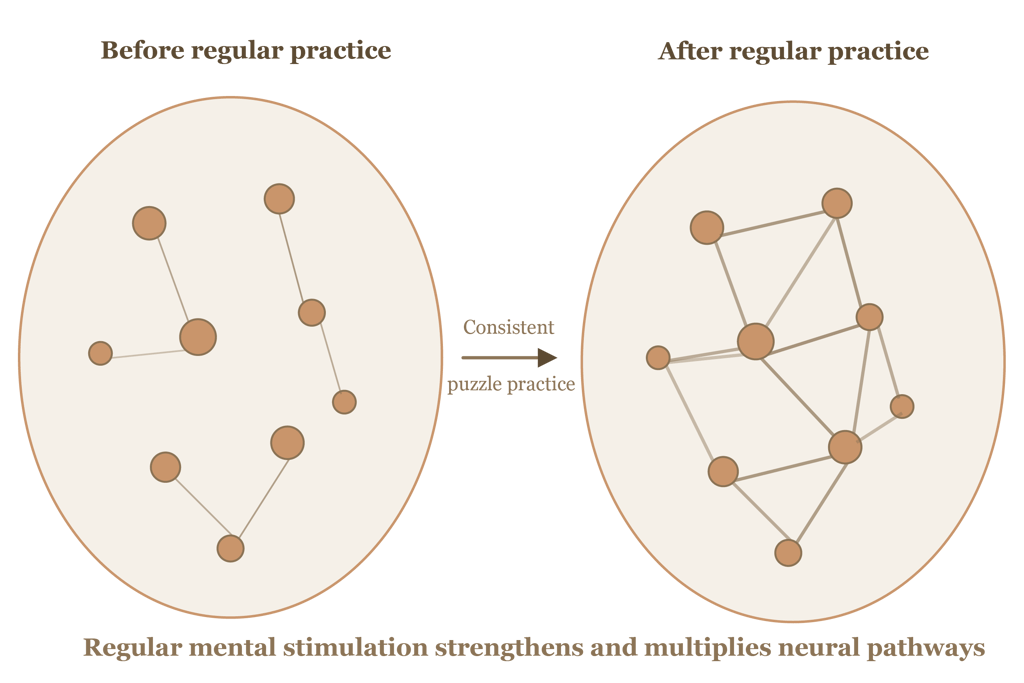
This matters because of a concept neuroscientists call neuroplasticity — the brain’s ability to form new neural connections throughout life. Every time you challenge your brain with a puzzle, you’re reinforcing existing pathways and potentially building new ones. It’s not a cure for cognitive decline, but it’s a meaningful form of mental maintenance.
A word of honest context: the Alzheimer’s Society, while acknowledging the positive findings, notes that regular puzzle-solving doesn’t yet guarantee prevention of dementia. But the evidence for cognitive maintenance — keeping what you’ve got working well — is robust and growing.
The bottom line
A word search isn’t just a grid of letters. It’s a multi-system brain exercise disguised as a simple game.
Sources
Wesnes et al., International Journal of Geriatric Psychiatry (2019)
Devanand & Doraiswamy et al., NEJM Evidence (2022)
Alzheimer’s Society (2019)
DOTTIE CROSS
Discover our modern website layout designed for effortless navigation.
Contact
hello@dottiecross.com
© 2026. All rights reserved.