
Part 4 - The Bigger Picture
Where word searches fit in a broader cognitive wellness routine
5/12/20262 min read

The Bigger Picture — Building a Puzzle Habit That Lasts
Word Search Puzzles & Brain Health — Part 4 of 4
How much is enough?
The University of Exeter research found a clear dose-response pattern: more frequent puzzle-solving correlated with better cognitive performance. But the sweet spot for most people isn’t hours of daily puzzling — it’s consistency. Aim for 15 to 20 minutes most days, or several shorter sessions spread across the week.
The COGIT-2 follow-up trial from Columbia and Duke is currently testing whether four crossword puzzles per week produces better outcomes than one per week in people with mild cognitive impairment. Early indications suggest frequency matters more than session length.
Building the habit
Anchor it to an existing routine. Pair your puzzle with something you already do daily — morning tea, a lunch break, or the quiet period before bed.
Progress the difficulty. Start with smaller grids and forward-only words. Move to larger grids with diagonal and backward words as your scanning speed improves. Themed puzzles add vocabulary enrichment on top of the cognitive workout.
Combine, don’t replace. Word searches work best alongside other mentally stimulating activities — reading, learning a new skill, social conversation, physical exercise. The Alzheimer’s Society emphasises that no single activity is a silver bullet; it’s the overall pattern of an engaged, active life that builds cognitive reserve.
An honest summary
Word search puzzles won’t prevent dementia on their own. No puzzle can make that promise. But the evidence is clear that regular, focused mental engagement — of the kind word searches provide — supports sharper cognition, better memory, reduced stress, and stronger attentional control. They’re accessible, affordable, screen-free, and genuinely enjoyable.
That’s a strong case for keeping a puzzle book within arm’s reach.
Sources
Devanand & Doraiswamy et al., NEJM Evidence (2022)
Wang et al., COGIT-2, International Journal of Clinical Trials (2025)
Wesnes et al., International Journal of Geriatric Psychiatry (2019)
Alzheimer’s Society (2019)
Word searches are powerful, but they’re most effective as part of a broader approach to cognitive wellness. Here’s how to make them work harder for you — and where they fit alongside other brain-healthy habits.
Word searches vs. other puzzle types
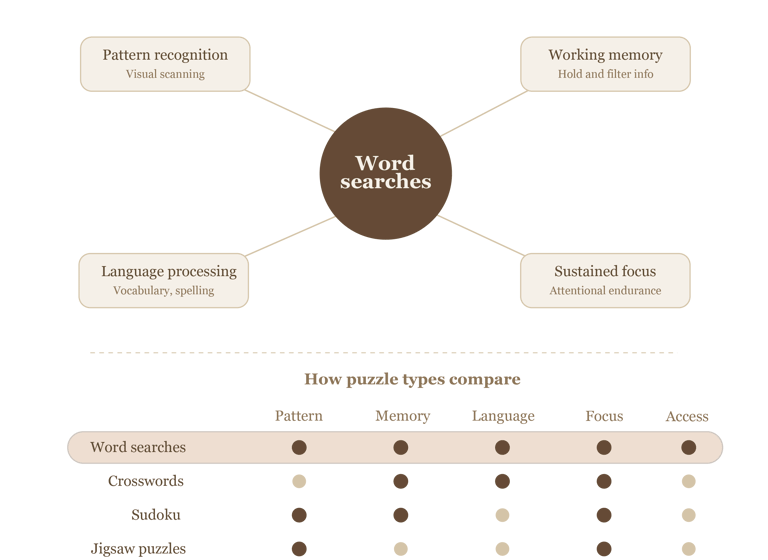
Different puzzles exercise different cognitive muscles. Crosswords lean heavily on vocabulary recall and general knowledge. Sudoku targets logical reasoning and spatial awareness. Jigsaw puzzles develop visual-spatial processing. Word searches occupy a useful middle ground: they combine visual scanning, pattern recognition, working memory, and language processing in a single low-pressure activity.
The Columbia/Duke research published in NEJM Evidence compared crossword puzzles directly to computerised brain games and found crosswords superior for cognitive outcomes in people with mild impairment. While word searches haven’t been studied in the same controlled trial format, they engage many of the same cognitive processes, making them a strong complementary tool.
The practical advantage word searches hold over crosswords is accessibility. They require no specialist knowledge, scale easily from simple to challenging, and can be picked up and put down without losing progress.
DOTTIE CROSS
Discover our modern website layout designed for effortless navigation.
Contact
hello@dottiecross.com
© 2026. All rights reserved.