
Part 3 - Stress & Focus
How a simple grid interrupts the cortisol loop and shifts you into rest mode.
5/12/20261 min read
The Stress Factor — How Word Searches Calm Your Mind
Word Search Puzzles & Brain Health — Part 3 of 4
There’s a reason people instinctively reach for a puzzle book when they need to unwind. The focused, repetitive nature of scanning a word search grid creates conditions remarkably similar to a mindfulness exercise — without the learning curve.
What’s happening physiologically
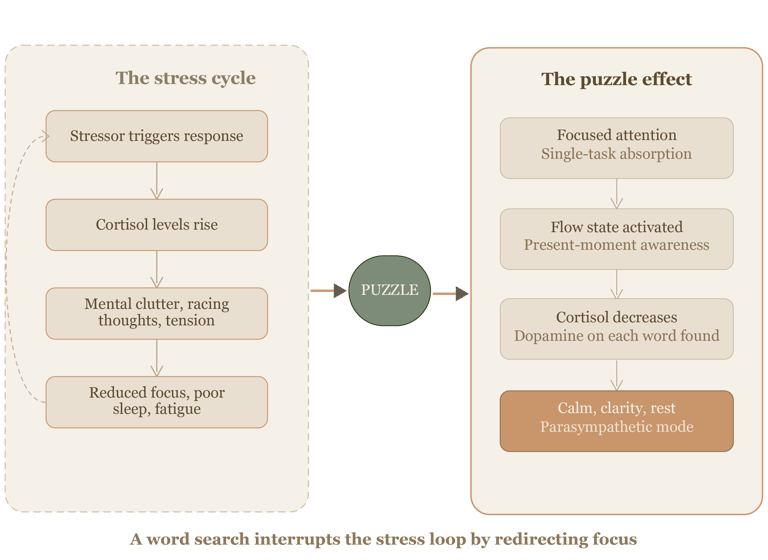
When you concentrate on finding words in a grid, your brain shifts from reactive mode — responding to emails, worrying about tomorrow — into a state psychologists call flow: complete absorption in a single task. This shift has measurable physiological effects. Research on puzzle-solving and stress shows that focused puzzle activity can lower cortisol, the body’s primary stress hormone, while triggering dopamine release as you spot each word.
The process also nudges your nervous system from sympathetic activation (fight-or-flight) toward parasympathetic mode (rest-and-digest). Blood pressure eases. Muscle tension drops. Mental chatter quiets.
Why it works better than scrolling
The contrast with digital downtime matters. Continuous screen use is associated with elevated cortisol and disrupted sleep patterns. A word search offers the opposite: a screen-free, self-paced activity with a clear beginning, middle, and end. There’s no algorithm feeding you content designed to provoke emotional reactions — just letters, a list of words, and your own focus.
Practical application
You don’t need long sessions to feel the benefit. Even 10 to 15 minutes of focused puzzle-solving can serve as an effective mental reset.
Morning warm-up: a quick puzzle with your coffee to ease into the day with focus rather than phone-scrolling. Afternoon reset: a mid-day puzzle break to counter the post-lunch energy dip. Evening wind-down: a themed puzzle before bed as a transition away from screens, supporting better sleep hygiene.
The key is consistency over intensity. Short, regular sessions build the habit and compound the calming effect over time.
Sources
Psychology Today (2024)
International Journal of Geriatric Psychiatry (2019)
Journal of the American Geriatrics Society
DOTTIE CROSS
Discover our modern website layout designed for effortless navigation.
Contact
hello@dottiecross.com
© 2026. All rights reserved.