
Part 2 - Who Benefits Most
From children building vocabulary to seniors preserving cognitive function
5/12/20262 min read
Who Benefits Most — And Why It Depends on Age
Word Search Puzzles & Brain Health — Part 2 of 4
Word search puzzles aren’t one-size-fits-all. The cognitive benefits shift depending on where you are in life, and understanding those differences helps you get more from every grid.
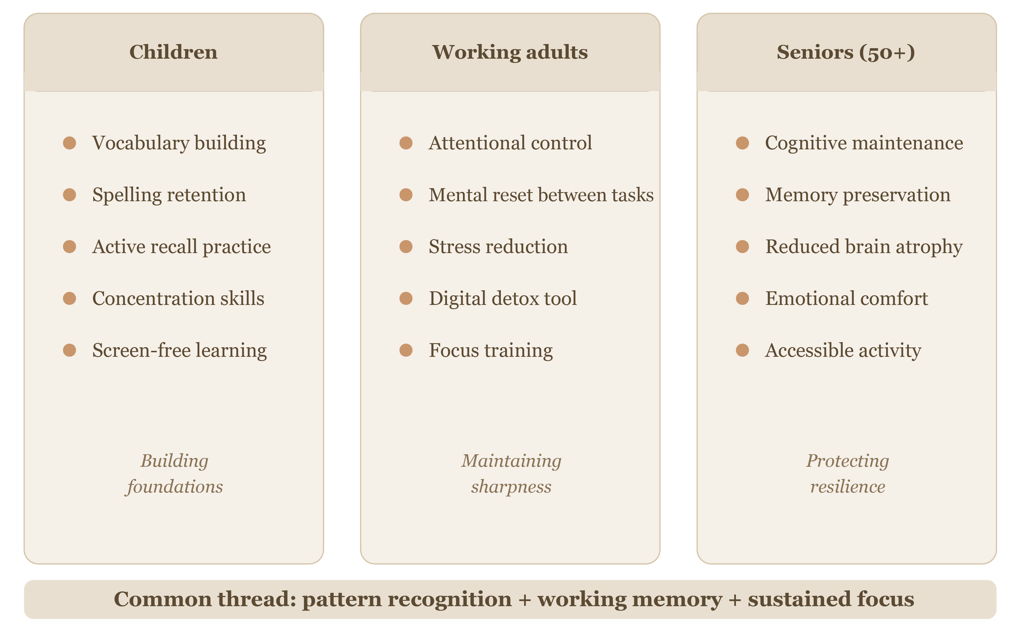
Older adults and seniors
This is where the strongest research exists. The University of Exeter/King’s College London study of 19,000+ participants found that older adults who solved puzzles regularly had cognitive function equivalent to people up to 10 years younger on standardised tests. That’s not a small margin — it’s the difference between struggling with daily tasks and managing them comfortably.
Many memory care facilities and senior centres already incorporate word searches into their programming. For older adults dealing with reduced mobility or social isolation, puzzles offer accessible mental stimulation that doesn’t require technology, a partner, or leaving the house. The Columbia/Duke trial specifically studied people with mild cognitive impairment and found measurable improvements in both cognition and daily functioning over 78 weeks.
Working-age adults
For adults juggling professional demands, the benefit is different but no less real. Word searches train attentional control — the ability to filter distractions and sustain focus on a single task. In an era of constant notifications, that’s a skill worth developing. A short puzzle session can serve as a mental reset between tasks, offering the kind of focused break that scrolling social media doesn’t provide.
Children and young learners
Research in educational settings shows word search puzzles strengthen vocabulary retention and spelling through active, contextual exposure to words. A 2023 study found that word search puzzles were effective tools for vocabulary building because they engage learners in active recall rather than passive reading. For young people, themed puzzles covering science terms, historical vocabulary, or foreign language words turn revision into a game.
The common thread
Regardless of age, the mechanism is similar: word searches demand that you hold information in working memory, scan systematically, and recognise patterns. That combination exercises the brain in ways that passive entertainment simply doesn’t. The key difference is what you’re protecting or building — for seniors, it’s cognitive maintenance; for adults, it’s focus and mental clarity; for children, it’s foundational language skills.
Sources
Wesnes et al., International Journal of Geriatric Psychiatry (2019)
Devanand & Doraiswamy et al., NEJM Evidence (2022)
Fitria (2023), ResearchGate
DOTTIE CROSS
Discover our modern website layout designed for effortless navigation.
Contact
hello@dottiecross.com
© 2026. All rights reserved.